What player retention means (and what “retention play” is)
In plain English, player retention is the share of people who try your game and then come back. If 1,000 players install on Monday and 270 open it again on Tuesday, your Day 1 retention is 27%. You’ll hear the same idea called game retention. Same measurement, slightly wider lens. Player retention asks whether this person returned. Game retention asks whether the game still holds a living audience. Retention play is not a sports formation. In games, it means the player chose to play again: one more session, one more day. That repeat choice is what the business runs on. Teams usually measure it on three days:- Day 1. Did the first session earn a second try? This is onboarding, clarity, and “was that fun?”
- Day 7. Did the first week create a habit? This needs goals, progress, and a reason to open the game midweek.
- Day 30. Is anyone still here after the novelty dies? This is depth, community, identity, and live content.
Remember: Player retention is whether this person came back. Game retention is whether the game still has a living audience.
What’s a “good” retention rate in 2026?
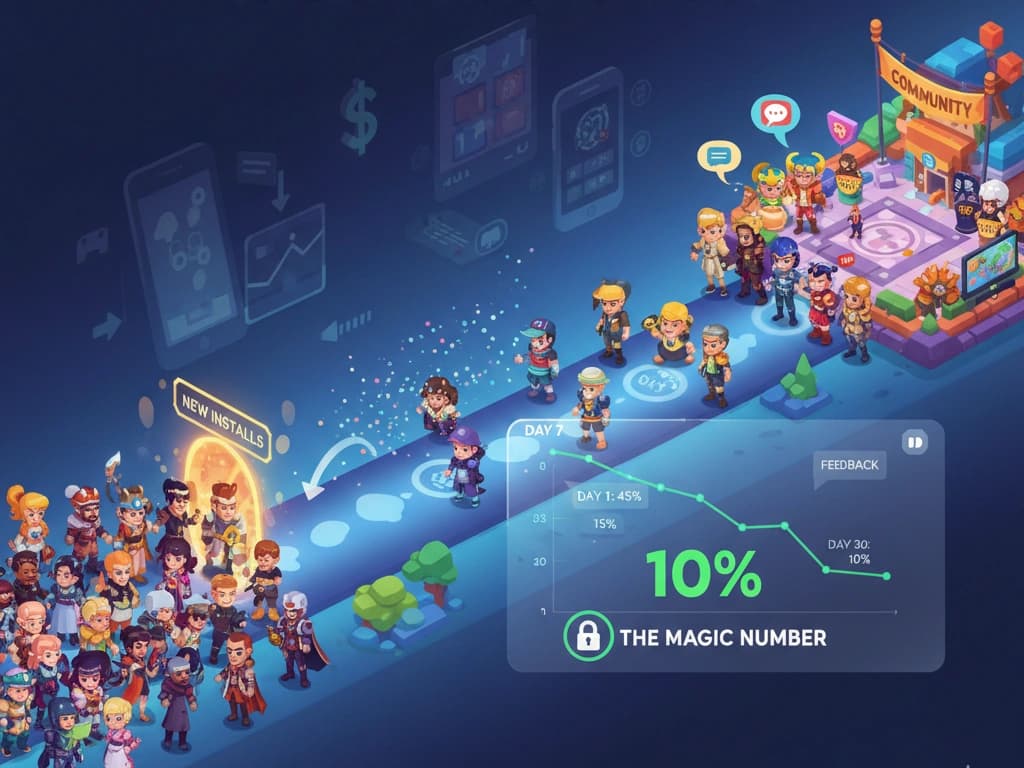
The old slide said free-to-play mobile sits at 35–50% Day 1 and that 10% Day 30 is the “magic survival number.” That is outdated. GameAnalytics’ 2026 Mobile & PC Gaming Benchmarks (opens in a new tab) tracked 16,000+ live mobile games (1,000+ monthly players) across 2025. The median game kept about 22% of players on Day 1, just under 4% on Day 7, and 0.7–0.8% on Day 30. The top 1% sat far above that: 64–68% Day 1 and 13–15% Day 30. So 10% Day 30 is not a baseline. Almost nobody hits it. A 2026 read of the same data (opens in a new tab) suggests a more honest working target for a marketed mobile game is closer to 35 / 15 / 5. Adjust’s 2026 Gaming App Insights (opens in a new tab) puts average gaming Day 1 around 27%, and it barely moved year over year. Most players get one session on install day, so that session has to do the selling.| What you’re looking at | Day 1 | Day 7 | Day 30 | Notes |
|---|---|---|---|---|
| Median mobile game | ~22% | ~4% | 0.7–0.8% | GameAnalytics 2026 (opens in a new tab), all live titles above 1k MAU |
| Marketed mobile (realistic bar) | 30–35% | 10–15% | 3–6% | Adjust (opens in a new tab) averages sit near 27% D1; AppFollow (opens in a new tab) puts commercial titles in this band |
| Top 10% mobile | ~40% | 11–12% | ~4% | The old “good Day 1” |
| Top 1% mobile | 64–68% | 25%+ | 13–15% | Where 10%+ Day 30 actually lives |
| Median PC game | ~7% | 1.7–1.8% | ~0.2% | Different shape. Longer sessions, fewer daily returns |
| Top live PC | 50–60% | 20%+ | ~10% | Comparable to top mobile, not to a story campaign |
Remember: 10% Day 30 is rare. Most games sit under 1%. Compare yours to its own row, not an old slide.
Why game retention matters more than installs
Downloads look great on a slide deck. Engagement pays the bills. Sensor Tower (opens in a new tab) counted 50.41 billion mobile game downloads in 2025, down 7.2%. In-app purchase revenue still hit $81.75 billion. Hours played barely rose. Same players, more value squeezed out of each one. Studios spent about $25 billion acquiring mobile players (opens in a new tab) in that same year. Helpshift’s 2026 recap (opens in a new tab) puts it simply: more than 95% of mobile game players are gone within 30 days. Buying more installs into that leak is not a growth plan. Keeping a player is cheaper than replacing them. Win-back work (opens in a new tab) is often cited at about one-fifth the cost of a new install. And high retention still brings the old perks:- Stronger community. Active players attract more players. Nobody likes empty lobbies.
- Steadier revenue. Loyal players spend more, more often.
- Better feedback. Long-term players actually tell you what’s working.
- Free marketing. Word of mouth from happy players beats any ad campaign.
Remember: The fight is for the next hour, not the first download.
Player retention strategies that actually work
A player retention strategy for your game is not a 40-tab spreadsheet. It is a clear answer to one question: why should this person open the game tomorrow?Remember: If you cannot say why someone should open the game tomorrow, you do not have a strategy yet.
1. Make onboarding painless
Your first impression decides a lot. If players hit confusion or a permissions wall, they’re gone. Get them into the real game fast. First-session guidance in 2026 (opens in a new tab) is blunt: core play in about 60 seconds, a real “this is fun” moment in about 90. Skip the essay. Defer the account create. Clash Royale still nails this. It teaches through play and hands you a small win early. One thing the old list often skipped: your ad and your first minute have to match. Players who installed for a trailer that lied churn first.Remember: If the first minute is confusing, there is no Day 1.
2. Keep things fresh
Stale games fade fast. Drop new content often: updates, events, even small shop changes. Those tell players the game is alive. Fortnite built an empire on that idea. Sensor Tower (opens in a new tab) saw live ops in 2025 shift toward repeat play, not launch fireworks. Mobile playtime is almost flat across the week, so a weekend-only event calendar is lazy. Put something out on a Wednesday. Put the juicy stuff on the days your players actually leave, often the first week and around Day 14. If Day 7 after an event drops, you didn’t retain anyone. You borrowed next week’s sessions.Remember: An event that steals next week’s sessions is not retention.
3. Reward progress people can see
People like seeing bars fill up. Levels, gear, and achievements keep players chasing the next milestone. World of Warcraft wrote the book. Make that progress personal, not only numeric. A title, a base, a skin, a rank, a world they built. Leaving then feels like leaving something behind, not closing a menu.Remember: Progress people can see is progress they do not want to abandon.
4. Build a community
Games aren’t just about gameplay. They’re about belonging. Guilds, leaderboards, and a place to talk all help. Rocket League thrives because of player culture and devs who show up. Empty social features are worse than none. A dead friends list tells people the party already left.Remember: A dead friends list is worse than no friends list.
5. Be fair with monetization
No one likes being squeezed. Offer real value, not pay-to-win shortcuts. Path of Exile still proves the point: cosmetics and quality-of-life, not power. A 2025 Steam study of 700+ games (opens in a new tab) found a moderately strong negative link between pay-for-advantage monetization and positive reviews, and the sourness grew the longer the game was out. Players will spend after they trust you. They will not stay if the shop is the boss fight.Remember: Cosmetics sell. Pay-to-win rents a session and burns the review score.
6. Test everything
A/B testing is how you find out what the first session actually does. Tutorials, pricing, difficulty, even button placement. Candy Crush does this nonstop, which is one reason it is still on charts. Test the first session before you test the season pass. Day 1 is the ceiling for every later number.Remember: A season pass cannot fix a first session that already lost them.
7. Add social spark
People stick around for people. Friends lists, co-op, competitive boards. Pokémon GO’s raids and teams turned casual players into a habit. Friends beat empty clans. Industry recaps keep landing on the same shape: players with a real social circle come back far more often. Start with a fast invite and a tiny party bonus. You can build the guild hall later.Remember: Friends beat empty clans. Start with a real invite, not a guild hall.
8. Win back lapsed players
Everyone drifts. Smart games make coming back easy: welcome-back rewards, catch-up, a “here’s what’s new” screen. Clash Royale’s comeback bonuses still work because they turn a drop-off into a short mission, not a guilt trip. Studios that do this well in 2026 (opens in a new tab) design the first 30 seconds of the return. Do not dump a lapsed player on the same home screen as a daily. Recap. Show what changed. Then let them play. A single login is not a win-back. Watch Day 7 after they return.Remember: The win-back is Day 7 after they return, not the login bonus.
9. Treat your VIPs like actual VIPs
Your top players are the core. Exclusive events, early access, a name on a board. Clash of Clans does this with leagues and tournaments. Do not make everyone a VIP. The word stops meaning anything.Remember: If everyone is a VIP, nobody is.
10. Listen to your players
This gets skipped a lot. Collect feedback and show that it moved something. Hellcard did this with Feature Upvote (opens in a new tab). Trust went up. Retention followed. Helpshift (opens in a new tab) also notes that a chunk of players will quit for good after one bad support experience. A stuck tutorial with nobody answering is a retention bug.Remember: A stuck tutorial with nobody answering is a retention bug, not a community problem.
11. Give them a reason to return tomorrow
If the first session ends with no next step, do not expect Day 1. Show one obvious hook before they quit. A reward that unlocks tomorrow. A mission one tap from done. A mode that opens after a night’s sleep. Streaks help if they feel generous. They hurt if missing Tuesday deletes a week of work. Your game should feel like a hobby, not a second job.Remember: If the session ends with no next step, do not expect them tomorrow.
12. Let players make content
You do not need a Roblox-sized creator economy. A map editor, featured community builds, or official mod support already creates a reason to come back. The 2025 UGC Impact Study from GameDiscoverCo and mod.io (opens in a new tab) looked at about 1,200 Steam games that made $1 million in month one. Titles with official UGC kept 75% higher concurrent users after two years and 115% after five. Baldur’s Gate 3 saw a 20% DAU lift after official mod support. Minecraft and Fortnite Creative are the loud versions of the same idea: when players help fill the catalog, the game does not go stale on your update schedule.Remember: When players help fill the catalog, the game does not go stale on your schedule.
13. Measure before you scale ads
If the bucket leaks, buying more installs just makes a bigger mess. Track install, tutorial start, tutorial finish, first win, first reward, second session, then Day 1 / 7 / 30. Split those numbers by ad creative and store. Adjust (opens in a new tab) has been loud about this in 2026: rising install costs mean you keep the players who already paid for themselves. Stores are starting to agree. Discovery systems increasingly reward games people keep opening, not games people tap once.Remember: If the bucket leaks, a bigger ad budget just makes a bigger mess.
Player retention software (the boring tools that save you)
You do not need a stack that costs more than the game. You need a few honest instruments.- Analytics. Something like GameAnalytics (opens in a new tab) so you can see D1, D7, D30, session length, and where the tutorial dies.
- Attribution. Adjust (opens in a new tab) or AppsFlyer (opens in a new tab) if you buy installs, so you know which ads create returners and which create ghosts.
- Live ops and experiments. Remote config, A/B tests, event calendars. Unity’s own LiveOps notes (opens in a new tab) keep repeating the same line: build this before launch, not in week eight.
- Feedback. A public board, in-game prompts, actual replies. Feature Upvote is one option. A Discord you ignore is not software. It is a complaint inbox.
Remember: Tools show you where players leave. They do not give them a reason to stay.
What this comes down to
Most of the work is respect for players’ time, attention, and money. If the game is satisfying and fair, people stay. If it isn’t, no live-ops calendar will save it. You’ll still test things that flop and ship updates that backfire. Keep listening, keep fixing what you find, and players notice.Remember: Fair and fun beats a live-ops calendar. People stay when the game is worth their time.